
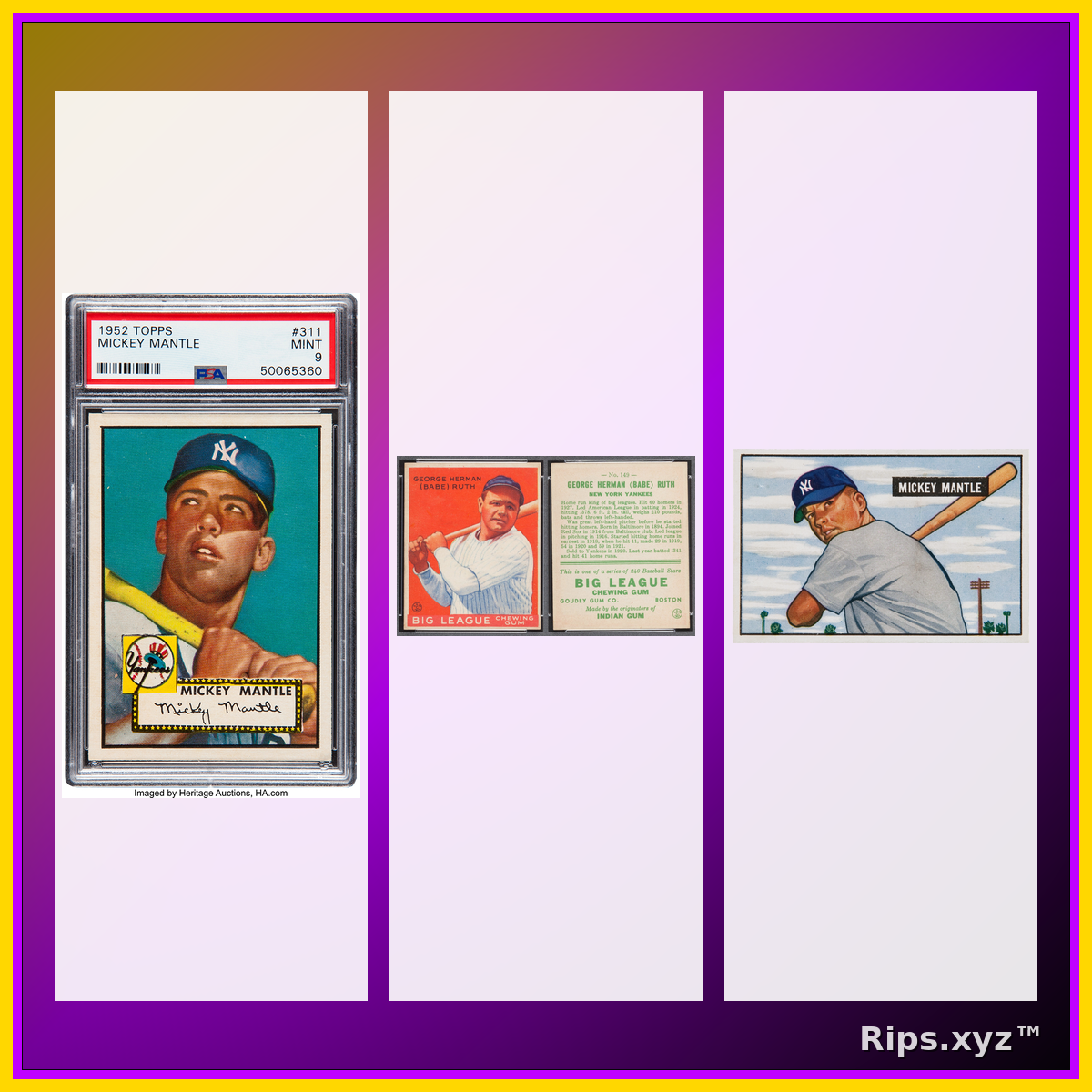
When a 1952 Topps Mickey Mantle in high grade sold for a record price at Heritage Auctions in August 2022—widely reported around $12 million—the headline traveled faster than the comps. Collectors heard “baseball cards are worth millions” and applied that to wax, rookies, and rip jackpots that share almost nothing with the asset that cleared. Record sales signal the top of the market—not unit prices for the middle. Rips.xyz™ treats them that way.
What the record sale actually was
The card was a known trophy asset: high grade for a condition-sensitive issue, deep provenance, auction-house marketing, and buyers treating iconic sports artifacts like fine art. High-grade 1952 Topps Mantle copies are extremely rare; #311 is the canonical postwar icon; PSA provided the shared condition language; Heritage provided trophy-lot infrastructure.
That was a unique-object auction, not a marginal trade on a fungible commodity. Record sales answer: did two parties agree this specific object was worth eight figures today? They do not answer whether your recent prospect slab clears next week or whether a rip pool is fairly priced.
Signals, not indices
After record sales, three effects appear: new entrants conflating trophy vintage with modern product, sellers raising unrelated asks because “the market is hot,” and thin books looking deep until sellers need bids. Serious collectors re-rate a small peer set—trophy vintage icons in gem condition—not the entire market.
Everything else gets narrative spillover: sentiment moves; fundamentals may not. Rips.xyz™ separates channels through FMV discipline—last sales on comparable objects, not headline adjacency.
Trophy lane vs tradable lane
Trophy lane: six- and seven-figure vintage icons, ultra-scarce patches, one-of-ones. Auction houses, private rooms, fractional platforms. Sparse prices; each sale is an event.
Tradable lane: modern base, inserts, most graded rookies, sealed wax at scale. eBay, breaks, rip platforms. Dense prices; daily flows.
The record Mantle is trophy lane. Most collector capital sits in tradable lane. When trophy lane sets a record, tradable lane often sees ask inflation without matching bid step-ups. Browse baseball cards with that lens.
Grade economics and downstream effects
On condition-sensitive vintage, one grade step can separate five-figure from eight-figure outcomes. Population reports constrain which objects can compete for trophy bids. Record sales encourage submission waves—mid-grade holders often overestimate reflexivity; headline buyers were not bidding on low-grade copies.
Modern PSA 10 populations behave differently—often large enough that gems trade like commodities within a set year. Record vintage sales do not linearly transfer to modern bands.
After the Mantle record, adjacent vintage icons saw stronger auction interest and vault inquiries; mass modern rookies and 2010s sealed wax largely did not structurally re-rate. Rip EV tracker pools price off listed comps unless operators choose to react—often marketing, not mark-to-market.
RWAs and everyday takeaways
Trophy records feed fractional and RWA marketing—access to icons most cannot afford whole. Fractional shares trade on platform rules; the underlying object clears on its own schedule. Operators may highlight vintage in marketing while inventory skews modern—read pool composition on Companies pages.
For everyday collectors: do not use trophy comps for tradable-lane exits; treat post-record ask spikes skeptically; let sealed wax thesis stand alone; keep rip EV tracker fee-first per how pack-rip EV actually works. Ask: did bids improve on my card, my grade, my venue? If not after a month, the headline was entertainment—not your comp.
Prior record cycles (Wagner, Ruth, Jordan) show the same pattern: media extrapolation to the mass market, then bifurcated returns where trophy assets persist and bulk inventory mean-reverts. Rips.xyz™ records those tails for culture; they do not replace diligence on the cards you actually hold.